Foreword
Canadian leaders are making large decisions about artificial intelligence (AI), and much of what they read about it is either written to sell them something or too general to act on. We could not find a monthly read that took one Canadian dataset, tested it honestly and said plainly what it means for the decision in front of you. This report is our attempt to fill that gap.
Each issue follows one question for the season, and this season it is whether AI will finally move Canada's productivity numbers. We link our sources as we go, keep the full method on our website, and put our predictions on the record so you can hold us to them.
Push back where you think we are wrong, tell us whether our observations match what you see in your own organization, and let us know what would make the next issue more useful to you. The three questions at the end take a minute, and a reply to the email that brought you this report reaches us directly.
Pamimo AkinjideWorld's Edge Group
Issue 01 · Published October 27, 2026
Canadian businesses tripled their AI use in two years while professional services, the early leader, stalled at a third
This season's question: Will artificial intelligence finally move Canada's productivity numbers?
Source: Statistics Canada, Canadian Survey on Business Conditions, tables 33-10-1167-01, 33-10-1004-01 and 33-10-0825-01 (second quarters of 2026, 2025 and 2024)
Two years ago, about one Canadian business in sixteen used artificial intelligence (AI); by this spring it was nearly one in five, according to Statistics Canada's quarterly business survey. If AI were going to lift productivity anywhere first, you would expect it in the law, accounting, consulting and engineering firms that adopted it earliest. Instead, that industry all but stopped adopting a year ago, and its hiring has barely moved, as the federal job vacancy survey shows. Our reading is that most firms have bought AI without changing how their work is done. The budgets being set this fall should pay for that change, not for more tools.
What this means for you
If you are setting a budget for fiscal 2027, the evidence argues against spending it on more licences or on hiring specialists. Spend it on changing one piece of work. Choose the task your people repeat most often, whether that is a first-draft summary, an audit memo, a proposal or a customer reply, and give one person a quarter to run it with one named tool. Count the hours the task takes before you start and again at the end. If the hours fall, change how that work is staffed and priced, because that is the step most firms appear to have skipped. If they do not fall, you have learned something useful for the price of a licence. Our November issue runs this exact test on a real professional task and reports what it cost.
Almost everyone is adopting
AI use rose in every province, from 13.1 percent of businesses in Manitoba to 25.1 percent in British Columbia, and businesses in cities are about twice as likely to use it as those in rural areas (Statistics Canada, table 33-10-1167).
Information and cultural industries, at 42.3 percent, and finance and insurance, at 40.4 percent, now use AI more than professional services, the early leader, does, and health care is close behind at 30.0 percent (Statistics Canada, table 33-10-1167).
None of this tells us whether AI is showing up in what Canadian businesses produce for each hour of work, which is the question we are tracking this season.
The payoff has not arrived
We compared 13 industries and found no sign of it yet: those using AI most in 2024 did not raise their output per hour any faster between 2023 and 2024 (Statistics Canada, table 36-10-0480). If anything the relationship ran slightly the other way, with a rank correlation of -0.31, but the margin of error is wide enough to include no effect at all (our method).
The test is weak because Statistics Canada's industry productivity figures stop in 2024, so it rests on a single year of growth, and early adopters may simply not have had time to see a return (Statistics Canada, table 36-10-0480). A better clue comes from the firms that went first.
Note: Productivity is real output per hour worked from table 36-10-0480, which Statistics Canada has made inactive; its latest year is 2024, so the industry test uses growth from 2023 to 2024 only. The two surveys match on 13 industries.
The firms that went first
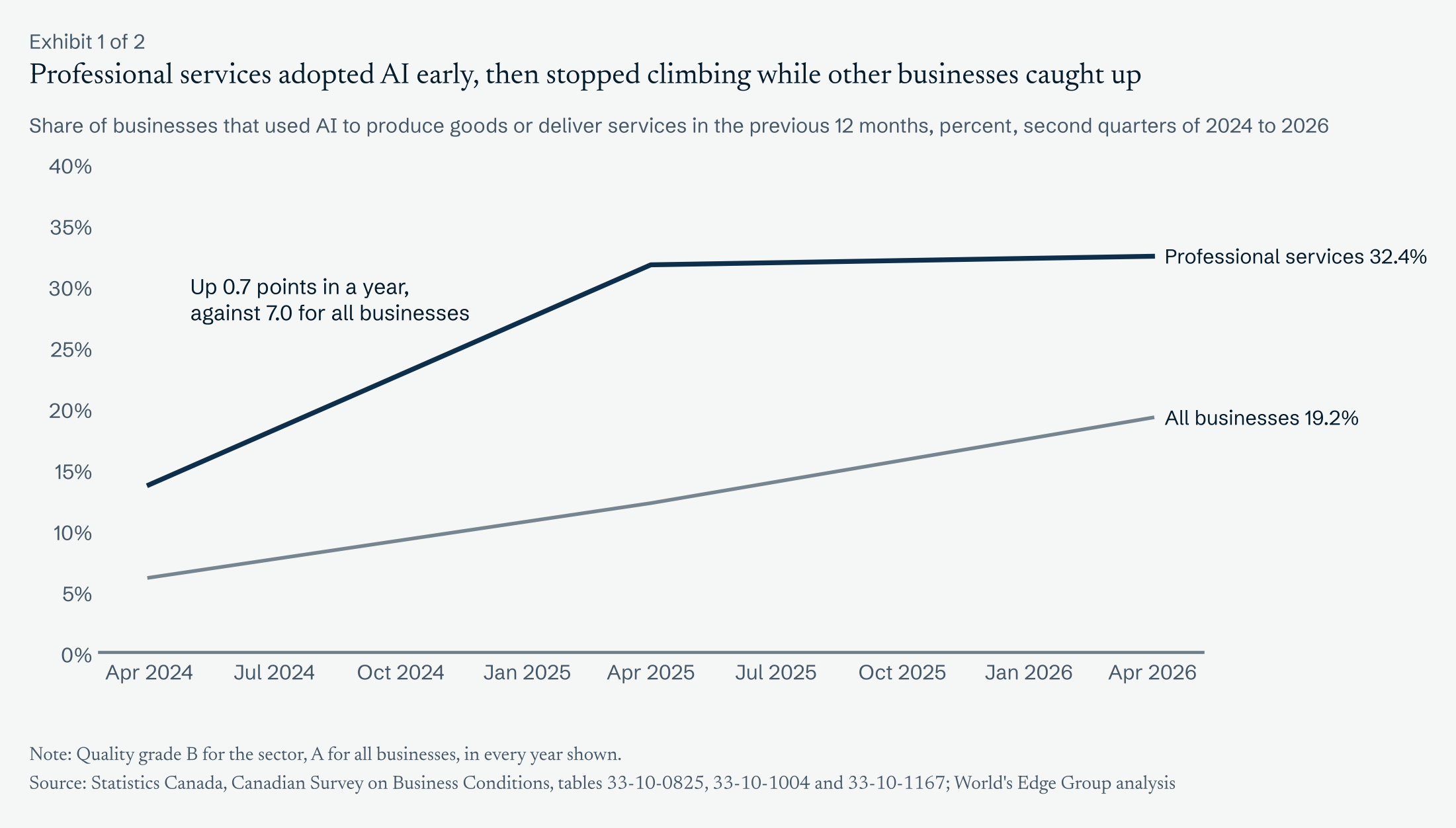
Professional services, the industry group that holds Canada's law, accounting, consulting and engineering firms, moved early. In 2024 its businesses were more than twice as likely as the average business to use AI, and by 2025 nearly a third of them did (Statistics Canada, table 33-10-0825; table 33-10-1004).
Over the year to mid-2026, though, the sector added less than one percentage point while businesses as a whole added seven, so a lead of 2.6 times the national rate has shrunk to 1.7 times (Statistics Canada, table 33-10-1167; our method).
More than half of these firms, 54.8 percent, still say they plan to use AI in the next year, twice the share of businesses overall (Statistics Canada, table 33-10-1207). But the work itself, and the people hired to do it, have not changed.
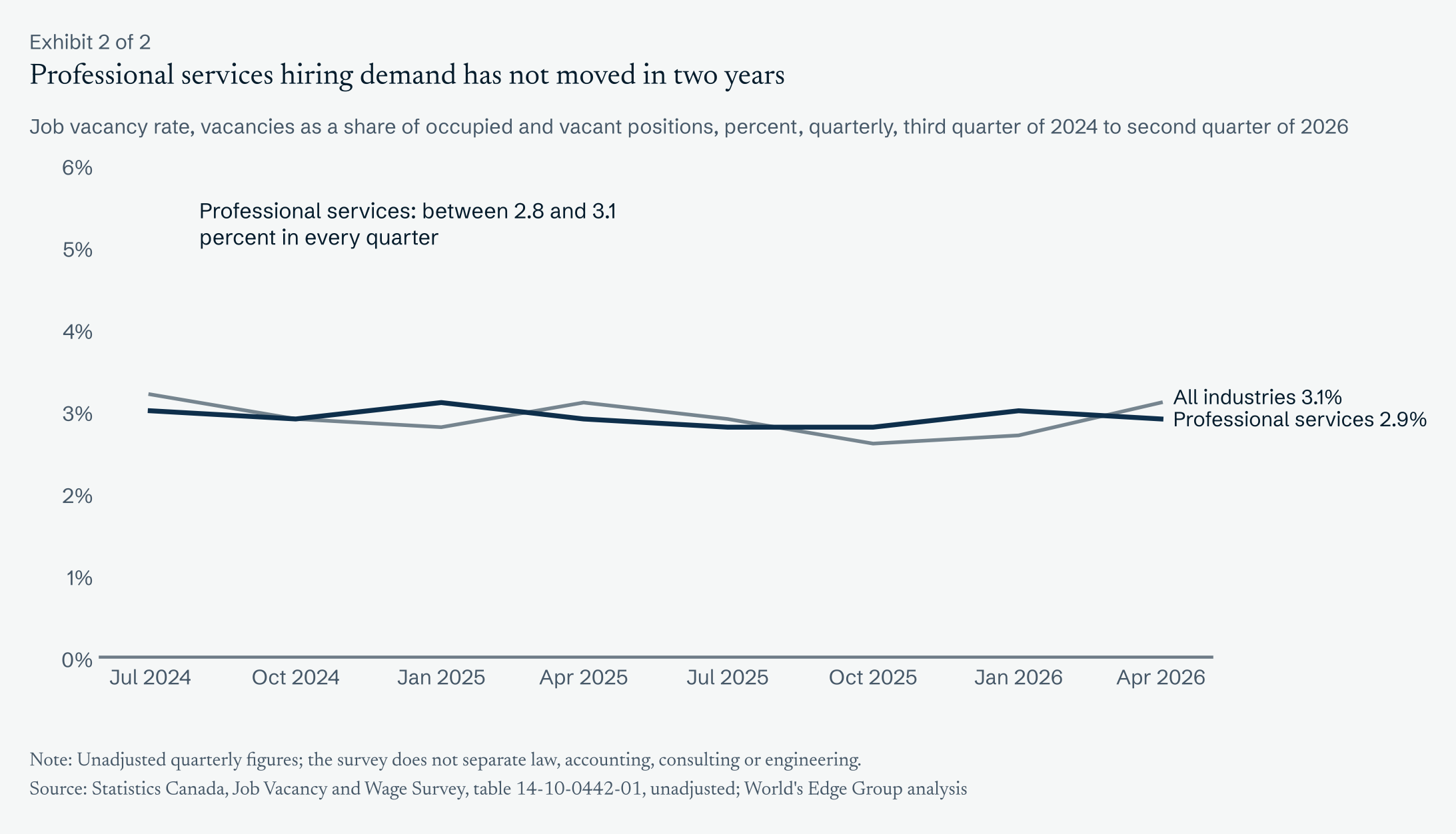
Over eight quarters, the sector's job vacancy rate has stayed between 2.8 and 3.1 percent, and its payroll has held near 1.23 million people (Statistics Canada, table 14-10-0442). Firms are paying a little more for the people they hire, with offered wages up 3.7 percent, but they are not hiring a different kind of person (Statistics Canada, table 14-10-0442).
Our own count of job postings, still thin, points the same way: at the six firms we could follow for a full year, 28 of 793 postings were for AI roles (our method).
Our reading is that this industry bought the tools and kept working the old way. With a third of its firms already using AI, the gain now has to come from changing the work around it, not from more adoption.
Where we could be wrong
Flat hiring might itself be the payoff, which is the strongest case against our reading. If firms are using AI to take on more work without adding people, the vacancy rate would look exactly like this, and that would be a productivity gain, not a stall. Flat payroll alongside rising revenue would point that way, and we will test it when the next revenue figures are published.
The survey counts any business that uses AI at all, so a firm with one licence counts the same as one that has rebuilt its document review, and it cannot separate law from engineering. Job titles also miss AI work done under ordinary role names.
If the next comparable survey, for the second quarter of 2027, shows professional services above 35 percent, this year's plateau was a pause rather than a stall (our method). If our postings data, once it covers ten or more firms, shows AI roles concentrated in a few large firms, the story becomes a split between leaders and everyone else.
Cost of Intelligence tracker
| Model | Input, US$ per million tokens | Output, US$ per million tokens | Change since last issue |
|---|---|---|---|
| OpenAI gpt-6.1-sol | 2.00 | 10.00 | first entry |
| Anthropic Claude Sonnet 5.5 | 2.00 | 10.00 | first entry |
| Google Gemini 3.1 Pro Preview | 2.00 | 12.00 | first entry |
The field test starts in November and will run a general-purpose model bought by the token against a real professional task, not an enterprise legal tool such as Harvey or Legora, so the result reflects what any firm can buy and price for itself. The tracker will then add the cost of that task for each model, so a price per million tokens becomes a price per piece of work.
Predictions
We log each call below with the date it resolves, and a later issue grades it, misses included.
| Claim | Resolves | Confidence |
|---|---|---|
| AI roles will be at least 5 percent of postings at the firms on our list that meet the coverage bar, in the twelve months to October 2027 (3.5 percent at six firms this year) | 2027-10-26 | 40 percent |
| The next comparable Canadian Survey on Business Conditions (CSBC) wave (second quarter of 2027) will show professional services AI use above 35 percent | 2027-06-30 | 50 percent |
| At least one top-ten Canadian law firm will post a partner-level AI role | 2027-10-26 | 50 percent |
| Statistics Canada's next comparable CSBC wave (second quarter of 2027) will show at least 25 percent of all Canadian businesses using AI | 2027-06-30 | 60 percent |
Reader pulse
These three questions take about a minute, and the answers feed the next issue.
- Does your firm have a funded AI budget line for fiscal 2027: yes, pilot only, or no?
- Who owns AI at your firm: a partner, the chief information officer, a committee, or nobody yet?
- What would make you fund it: a client ask, a competitor move, a cost number, or nothing?
Answer in the reader pulse form
About the data
The national and sector figures are Statistics Canada's own: the Canadian Survey on Business Conditions for AI use, second quarters of 2024 to 2026, and the Job Vacancy and Wage Survey for hiring (Statistics Canada, table 33-10-1167; table 14-10-0442). Our firm postings cover 61 law, accounting, consulting and engineering firms, collected October 10, 2026, and only six met our coverage bar, so they count as supporting evidence, not a finding (our method).