Foreword
The people who grow, process, ship and finance what Canada sells abroad often have to commit to a sale before the trade policy behind it has settled, and the analysis they can find tends to arrive after the decision or without the data behind it. This report is our attempt to fill that gap.
Each issue follows one question for the season, and this season it is whether Canada can capture the value from what it grows and digs. Each issue also carries Corridor Watch, which follows one export market at a time. We link our sources as we go, keep the full method on our website, and put our predictions on the record so you can hold us to them.
Push back where you think we are wrong, tell us whether our observations match what you see in your own markets, and let us know what would make the next issue more useful to you. The three questions at the end take a minute, and a reply to the email that brought you this report reaches us directly.
Pamimo AkinjideWorld's Edge Group
Issue 01 · Published October 27, 2026
China retook half of Canada's canola seed after the duty fell, but meal and peas reopen only to December 31
This season's question: Can Canada capture the value from what it grows and digs? · Corridor Watch this issue: India
For six months, China all but stopped buying Canadian canola seed. Under a 75.8 percent anti-dumping deposit it took just 5.4 percent of Canada's seed exports from September to February, according to Canadian Grain Commission export records and RealAgriculture. When Beijing replaced the deposit with a 5.9 percent duty on March 1, it came straight back, taking 48.3 percent from March to August, as Global Affairs Canada and the same records show. The same agreement reopened China to Canadian canola meal and peas, but only until December 31, reported Canadian Broadcasting Corporation (CBC) News. Seed is back for five years. Anyone booking meal or pea cargoes for January and February is selling into a door that may close on New Year's Day.
Source: Canadian Grain Commission (CGC), the federal regulator that records every tonne of grain leaving the country, "Exports of Canadian grain from licensed facilities", monthly file to August 2026, retrieved October 10, 2026; World's Edge Group analysis
What this means for you
China's duty on seed is a five-year anti-dumping order, separate from the suspension, so seed sales can go ahead on normal commercial terms (Global Affairs Canada). For meal and pea cargoes loading in January and February, make China conditional on Beijing announcing that it has extended the suspension; we put the odds of an extension at 55 percent (our predictions ledger). Line up the fallback now, before you need it. India, Bangladesh and the United States carried Canadian product through 2025-26, and India kept buying peas through its own new duty, though at a lower price per tonne than a year earlier (Canadian Grain Commission; United Nations Comtrade). All of this rests on six months of trade since the ruling, and if the September export figures break the pattern, we will say so in November.
How fast China came back
While the deposit applied, China bought no Canadian canola seed at all in September, October or January (Canadian Grain Commission). Once the lower duty took effect, China's share jumped by 42.9 percentage points, far more than ordinary month-to-month swings would explain (our method).
Canada's customs records tell the same story in dollars, with China's share of seed export value rising from 5.7 to 46.9 percent (Statistics Canada, Canadian International Merchandise Trade). The timing sits too close to the policy dates to be an effect of the crop.
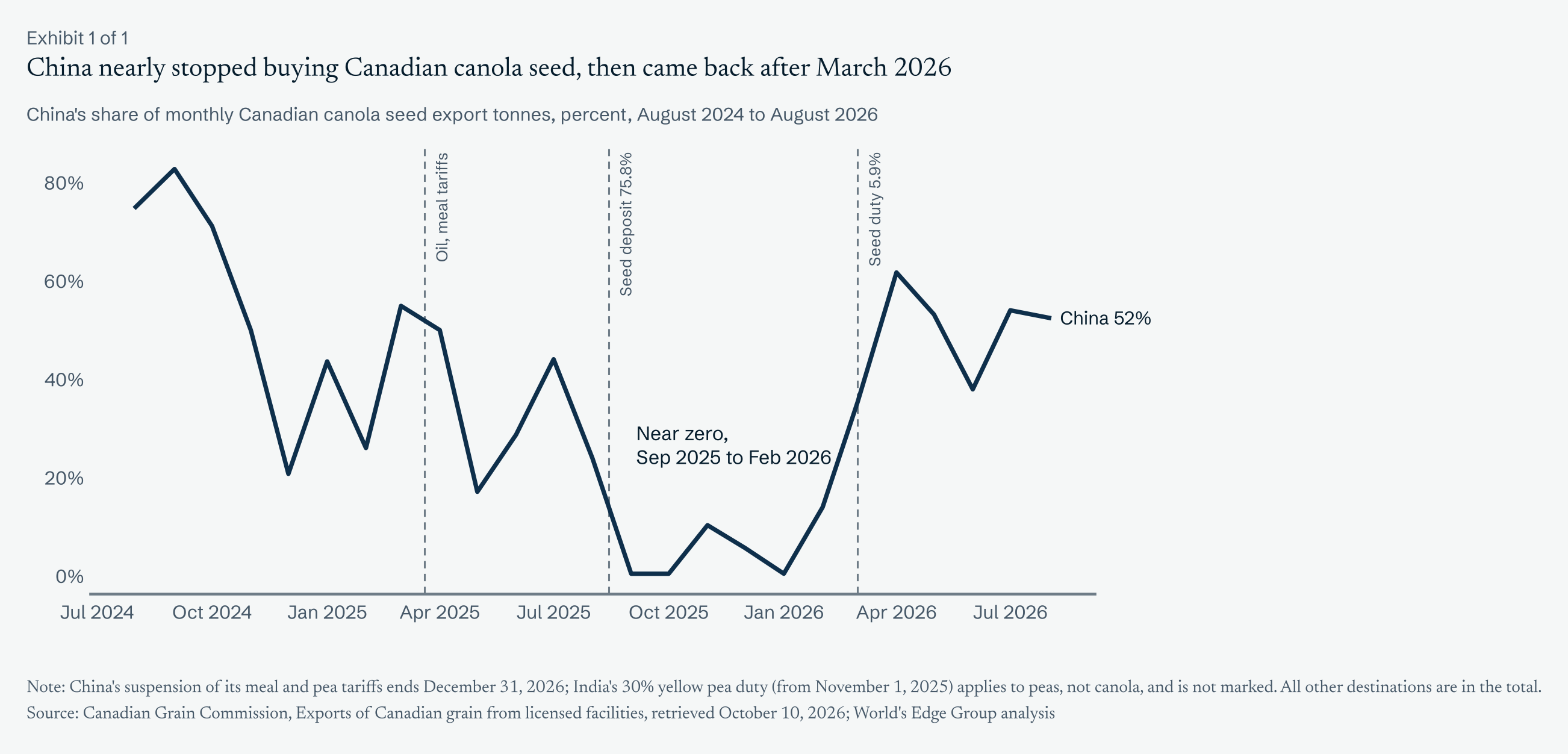
China took 52.0 percent of Canadian seed tonnes in August 2026, about half the trade, against the 74.6 percent it took two years earlier (Canadian Grain Commission).
What happened while China was gone
Over the crop year that ended in July 2026, China's share of Canadian canola seed exports fell from 49.3 to 28.2 percent, yet total exports fell only 5.1 percent (Canadian Grain Commission). Japan held steady at about 18 percent, Mexico rose from 9.2 to 13.4 percent, Pakistan went from almost nothing to 8.1 percent, Bangladesh from 2.0 to 6.2 percent and Germany from 0.7 to 4.5 percent (Canadian Grain Commission).
The trade moved to other buyers rather than shrinking, which matters for any meal or pea shipper facing a closed door in January.
The deadline that matters
Before China lifted its pea tariff, India was the main buyer, taking 51.3 percent of Canadian pea exports from September to February (Canadian Grain Commission). From March to August, China took 66.4 percent, and by August it was taking almost every tonne that left the country (Canadian Grain Commission).
Canola meal followed the same path, with China's share of its export value rising from 1.3 to 34.8 percent (Statistics Canada, Canadian International Merchandise Trade). The United States is still the main buyer of meal, taking 62.7 percent of export value from March to August against 75.8 percent in the six months before, so the December 31 cliff threatens the second market for meal and the first market for peas (Statistics Canada, Canadian International Merchandise Trade; our method). Canola oil is still facing China's 100 percent tariff, and its sales to China fell to about C$2,200 from March to August, against C$166 million in crop year 2024-25 (Statistics Canada, Canadian International Merchandise Trade; Dentons). Most of that oil went south instead: the United States took 95.2 percent of Canadian canola oil export value from March to August 2026, and 87.6 percent over the crop year that ended in July, so the tariff cost Canada its second market for oil, not its first (Statistics Canada, Canadian International Merchandise Trade; our method).
So Canada's pea and meal trade has swung toward a buyer whose welcome expires on December 31 unless Beijing extends it (Global Affairs Canada; CBC News). Winter planning should be built around that date rather than the seed headline.
Corridor Watch: India
India bought Canadian peas while China was closed and would likely do so again. Last November it put a 30 percent duty on yellow peas, ending a duty-free window that had been due to run to March 31, 2026 (Notification No. 46/2025-Customs; Reuters, via Khaleej Times).
Indian buying held up through the duty: India's own customs records show 872,100 tonnes of dried peas imported from Canada between November 2025 and July 2026, up from 728,700 tonnes a year earlier (United Nations Comtrade). The total value barely moved, from US$293.7 million to US$295.0 million, so the average declared price per tonne fell from about US$403 to about US$338 (United Nations Comtrade; our method). Lentils, which carry no new duty, rose more sharply, from 502,700 to 874,300 tonnes (United Nations Comtrade). India is also the first market for Canadian lentils, at 31.0 percent of export value over the crop year that ended in July 2026, with the United Arab Emirates second at 9.3 percent (Statistics Canada, Canadian International Merchandise Trade; our method).
These are customs values before duty, and the trade code includes peas other than yellow peas, yet the direction is clear enough for planning (United Nations Comtrade). For a winter shipper, India means more volume at a lower price if China closes in January.
Where we could be wrong
Export records show where cargoes were declared to be going, not who finally bought them, so transshipment hubs can look bigger than they are. Container shipments of pulses are recorded less completely than bulk grain, and one large vessel can move a month's share by ten points, which is why we compare six-month windows rather than single months. We would change our view on seeing September and October export files that reverse the shift, a revision to the Grain Commission's record, or any change to the December 31 end date (our method).
Predictions
We log each call below with the date it resolves, and a later issue grades it, misses included.
| Claim | Resolves | Confidence |
|---|---|---|
| China's share of Canadian canola seed export tonnes in crop year 2026-27 (August 2026 to July 2027) will be at least 45 percent | 2027-08-31 | 60 percent |
| India will not reopen a duty-free window for yellow peas before its 2027 rabi (winter crop) harvest | 2027-04-30 | 70 percent |
| China will extend its suspension of the 100 percent tariffs on canola meal and peas beyond December 31, 2026 | 2027-01-15 | 55 percent |
Reader pulse
These three questions take about a minute, and the answers feed the next issue.
- Since August, have you changed where you plan to sell or finance the 2026 crop: yes, considering, or no?
- If the tariffs stay, which market would you add first: the United States or Mexico, South Asia, Southeast Asia, Europe, or another?
- What is your biggest uncertainty for the winter shipping window: tariffs, freight, price, or demand?
Answer in the reader pulse form
About the data
Export shares come from the Canadian Grain Commission's monthly exports by destination, August 2024 to August 2026, checked against Statistics Canada's customs records (Canadian Grain Commission, exports by destination; Statistics Canada, Canadian International Merchandise Trade). Tariff dates come from published reporting of each notice; the notices themselves have not yet been read (our method).